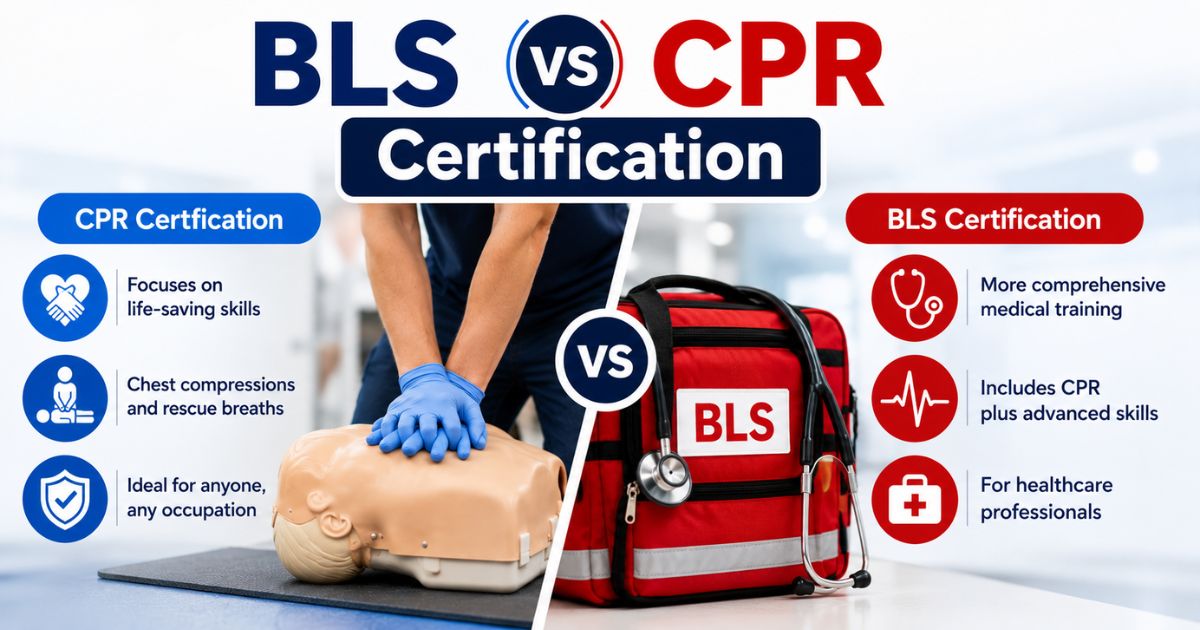
Overview: This blog explains the difference between CPR and BLS certification in simple terms. It helps readers understand who needs each course and why both matter in real-life emergencies. It also guides people searching for CPR training or CPR classes in Dallas to choose the right option based on job roles and responsibilities.
What if someone collapses just a few feet away from you? Would you know what to do?
It could happen in a hospital, an office, a school, a gym, or even during a family gathering. Those first few minutes before emergency medical services arrive are often the most important. The person nearby may be the only one who can help.
That is why learning CPR is more than earning a certificate. It is learning how to stay calm, take action, and possibly save a life. If you are searching for CPR training Dallas or beyond, you have likely seen two options: CPR certification and Basic Life Support (BLS).
They share many of the same skills, but they are not designed for the same people. Choosing the right course depends on where you work, who you care for, and the situations you may face.
What Is CPR Certification?
CPR stands for Cardiopulmonary Resuscitation. It teaches people how to respond when someone’s heart stops beating or they stop breathing.
A CPR course usually covers:
- Recognizing cardiac arrest
- Calling emergency medical services
- Performing chest compressions
- Giving rescue breaths when needed
- Using an Automated External Defibrillator (AED)
- Basic first aid, depending on the class
These skills are meant for everyday emergencies. You do not have to work in healthcare to use them.
Think about a teacher helping a student during recess. A coach responding to an athlete during practice. A coworker helping someone who suddenly collapses in the break room. These situations happen without warning, and trained people can make a real difference before professional help arrives.
What Makes BLS Different?
Basic Life Support, or BLS, builds on CPR by preparing healthcare professionals for emergencies they may face on the job.
Along with CPR, BLS training includes:
- High-quality CPR for adults, children, and infants
- Team-based resuscitation
- Two-person CPR
- Bag-mask ventilation
- AED use in healthcare settings
- Fast patient assessment
Healthcare emergencies are often managed by a team, not one person. BLS teaches participants how to communicate clearly, divide responsibilities, and work together while providing life-saving care.
Who Should Take CPR Certification?
CPR certification is a good choice for people who want to be prepared for emergencies at work or in everyday life. It is commonly taken by teachers, childcare providers, coaches, fitness trainers, office employees, security staff, construction workers, parents, and caregivers.
Many people first complete CPR training because their job requires it. Over time, they realize these skills are useful in many situations. One day, the person who needs help may not be a stranger. It could be a coworker, a family member, a friend, or even a neighbor.
Who Needs BLS Certification?
Healthcare professionals face medical emergencies much more often.
A nurse may respond when a patient’s heart suddenly stops. A dental professional may need to assist someone having a medical emergency during treatment. Emergency medical personnel begin life-saving care within moments of arriving at the scene.
These situations require more than basic CPR.
BLS certification prepares healthcare professionals to work as a team, perform advanced CPR techniques, and respond quickly in busy clinical environments.
It is commonly required for:
- Nurses
- Physicians
- Dentists
- Dental assistants
- Emergency medical personnel
- Respiratory therapists
- Physical therapists
- Medical and nursing students
The Biggest Difference Is Where You Will Use the Skills
The techniques taught in CPR and BLS overlap, but the setting is very different.
A CPR course prepares someone to help until emergency responders arrive. BLS prepares healthcare professionals to begin advanced care immediately while working with other trained providers. For example, an office employee may be the first person helping a coworker until an ambulance arrives.
A nurse inside a hospital is already part of the emergency response team. They need extra training because they are expected to provide a higher level of care. That is why BLS includes additional skills that are not part of a standard CPR class.
Why Hands-On Practice Matters
Watching a video or reading instructions is helpful, but emergencies are stressful. When someone’s life may depend on your actions, confidence becomes just as important as knowledge.
Hands-on training allows participants to practice:
- Chest compressions
- Rescue breathing
- AED use
- Adult, child, and infant CPR
- Team-based emergency response
Practicing these skills helps people react more naturally during real emergencies instead of freezing or second-guessing themselves.
Choosing Between CPR training Dallas and BLS
If you are trying to decide which course you need, start by thinking about your role.
Ask yourself:
- Do I work in healthcare?
- Am I required to have BLS certification?
- Do I simply want to be prepared for emergencies?
- Is this certification required by my employer or school?
If you work outside healthcare, CPR certification is often the right choice. If you provide patient care or are entering the medical field, BLS is usually required.
Trusted training providers like Texas OnSite CPR offer both CPR and BLS courses, making it easier for individuals and businesses to choose training that matches their needs.
What to Expect from CPR classes Dallas
A good CPR course should offer more than just a certification card. It should include hands-on practice, AED training, experienced instructors, and a nationally recognized certification. Small class sizes and flexible scheduling can also improve the learning experience.
Reliable CPR classes Dallas offer onsite workplace training and renewal courses, making it easier for participants to keep their certification current while refreshing important life-saving skills.
It Is More Than a Job Requirement
Many people sign up for CPR or BLS because they have to. It is required before starting a new job, joining a healthcare program, or meeting workplace safety standards. But after completing the class, many leave with something much more valuable than a certificate.
They leave knowing they can step forward instead of standing back. They know how to recognize an emergency, begin CPR, and use an AED until emergency responders arrive. That confidence can stay with them for years and may one day help protect someone they know and care about.
Be Ready When It Matters Most!
CPR and BLS both teach life-saving skills, but they serve different purposes. CPR certification prepares everyday people to respond during emergencies at work, at home, or in public. BLS builds on those same skills with advanced training for healthcare professionals who care for patients as part of their daily responsibilities.
If you are exploring CPR training Dallas or beyond, Texas OnSite CPR offers hands-on training for healthcare professionals, workplaces, and community members, helping participants gain practical skills that can make a real difference when every second counts.
Contact Texas OnSite CPR today to learn more about available courses, schedule a class, or find the training option that best fits your needs.
FAQs
Q1:What is the main difference between CPR and BLS certification?
CPR teaches basic life-saving skills for everyday emergencies, while BLS includes advanced techniques and team-based care designed mainly for healthcare professionals.
Q2:Who should take BLS certification instead of CPR?
BLS certification is recommended for nurses, physicians, dental professionals, emergency medical personnel, healthcare students, and others involved in direct patient care.
Q3:Who can benefit from CPR training Dallas?
CPR training Dallas is suitable for teachers, parents, coaches, office employees, childcare providers, healthcare workers, and anyone wanting life-saving emergency response skills.
Q4:What can I expect during CPR classes Dallas?
Most CPR classes Dallas include hands-on CPR practice, AED training, instructor guidance, skills testing, and nationally recognized certification upon successful course completion.
Q5:How long is a CPR or BLS certification valid?
Most CPR and BLS certifications remain valid for two years. Renewal training helps keep certification current and refreshes important life-saving skills.


BLS Provider CPR Classes for Individuals at our 3 Locations

George Brown
All of our staff are now trained in CPR. We now have the highest safety standards in our industry in Texas.
~ G-tech Industrial
Texas OnSite CPR
Text or Call: 817-992-0585
Email: info@texasonsitecpr.com
Contact Us Texas OnSite CPR © 2026.Nancy Stetson
To have our training onSite made it so much easier to get all of our employees trained in CPR.
~ Buffalo Ranch