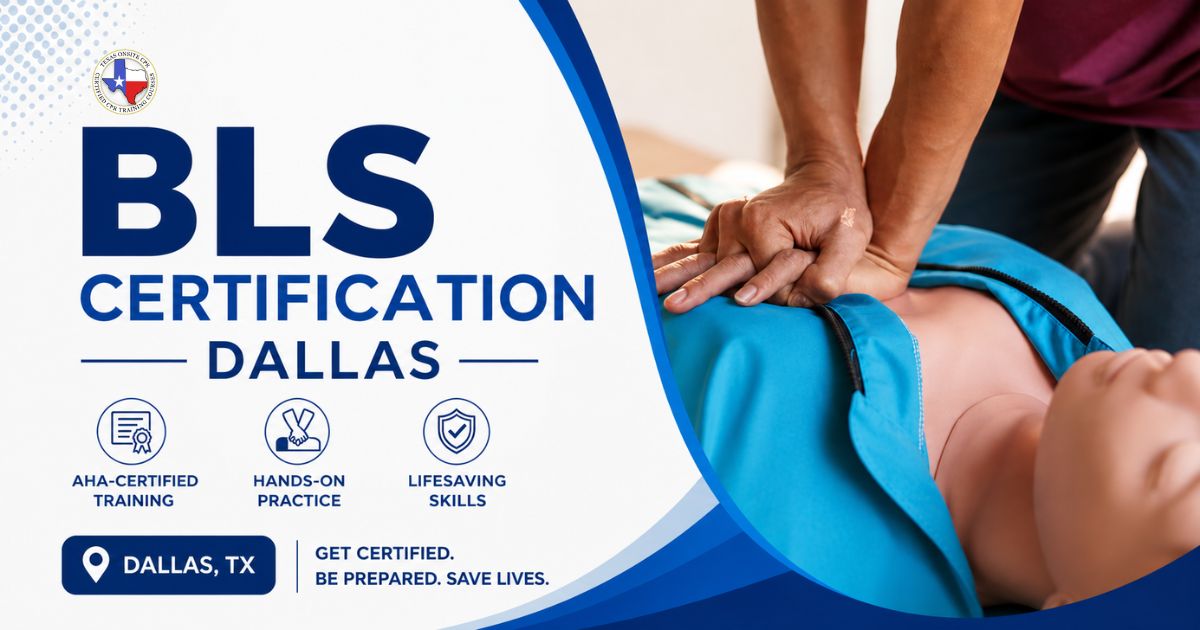
Quick Overview: This blog explains the key skills taught in BLS training, including CPR, AED use, choking response, airway support, and teamwork. It highlights how BLS classes in Dallas help learners gain hands-on experience for real emergencies. The guide is simple, clear, and useful for healthcare workers, caregivers, and anyone wanting to improve emergency response skills.
It usually starts as an ordinary moment. Someone is talking, walking, or working—and then suddenly they collapse. No warning, no time to prepare. In that short pause, people often freeze because they are unsure what to do.
BLS training helps remove that confusion. It gives simple steps that guide action when things feel chaotic. Instead of panic, there is structure. Many people take BLS certification Dallas at Texas OnSite CPR to learn how to respond in these exact moments where every second matters.
What BLS Training and Why It Matters
BLS stands for Basic Life Support. It focuses on the first actions taken during life-threatening emergencies. These skills are used when someone is not breathing normally, has no pulse, or is choking.
The goal is simple. Keep the person alive until medical help takes over.
BLS training is widely used in hospitals, clinics, schools, and workplaces. It is also useful for anyone who wants to feel more prepared in emergencies. Professional programs help learners understand both the steps and the reasons behind each action. This makes response more confident and effective.
CPR Skills That Form the Core of BLS Training
One of the most important parts of BLS training is CPR (Cardiopulmonary Resuscitation). This is the first response when a person’s heart or breathing stops. Learners are trained step by step on how to act quickly.
They learn how to:
- Check if the person is responsive
- Call emergency services without delay
- Start chest compressions immediately
- Maintain correct depth and rhythm
- Give rescue breaths when needed
CPR is not just about technique. It is about timing. Even a short delay can reduce survival chances.
That is why BLS certification programs focus heavily on hands-on CPR practice. Repeated training helps build confidence so actions become automatic in real situations.
AED Training and Safe Use Skills
An AED (Automated External Defibrillator) is a small device used during sudden cardiac arrest. It checks heart rhythm and delivers a shock if needed. BLS training teaches learners how to use this device safely and quickly.
They learn how to:
- Turn on the AED immediately
- Place pads correctly on the chest
- Follow voice instructions step by step
- Ensure no one touches the patient during analysis
- Deliver a shock if advised
- Continue CPR after use
The AED is designed for simple use, even in stressful situations. But practice is still important. It helps reduce hesitation and improves response time.
Many learners in BLS classes practice AED steps multiple times to feel more prepared during real emergencies.
Choking Response Skills That Save Lives
Choking is another common emergency in both adults and children. It can happen while eating, talking, or even during normal activities. BLS training teaches how to respond quickly when a person cannot breathe due to a blocked airway.
Learners are trained to:
- Recognize signs of choking
- Encourage coughing if the person can still breathe
- Perform abdominal thrusts (Heimlich maneuver)
- Use chest thrusts for infants or special cases
- Continue care until the object is removed
These steps must be done correctly and quickly. That is why practice is an important part of training.
Basic Patient Assessment Skills
Before starting CPR or using an AED, it is important to quickly understand what is happening. BLS training teaches learners how to assess the situation in a few seconds.
They learn to:
- Check responsiveness
- Look for normal breathing
- Identify signs of cardiac arrest
- Decide when to start CPR immediately
This quick assessment helps avoid delay. In emergencies, even a few seconds can make a difference. Learners are trained to stay calm and focus on simple checks instead of panic.
Airway and Breathing Support Skills
Keeping the airway open is an important part of saving a life. Without oxygen, the brain can get damaged quickly. BLS training teaches how to support breathing until help arrives.
Learners practice how to:
- Open the airway using head-tilt and chin-lift
- Give rescue breaths correctly
- Ensure air is reaching the lungs
- Maintain steady breathing support during CPR
These steps help keep oxygen flowing to the body during emergencies.
Teamwork Skills in Emergency Response
In real life, emergencies are often handled by more than one person. That is why BLS training also focuses on teamwork.
Learners are taught how to:
- Divide roles during emergencies
- Start CPR while another person calls for help
- Assign someone to bring or use the AED
- Communicate clearly under pressure
Team coordination helps reduce confusion and improves response speed. Programs like BLS classes often include group practice sessions so learners understand how to work together smoothly.
Why Hands-On Practice Matters So Much
Reading about CPR is not enough. Real emergencies require quick action without thinking too much. That is why BLS training focuses heavily on hands-on practice.
Practice helps learners:
- Build muscle memory
- Improve compression strength and speed
- Reduce panic during emergencies
- Act faster under pressure
- Work better in teams
When skills are practiced repeatedly, they become easier to recall in real situations. Many learners in BLS certification Dallas say practice sessions make them feel more confident and less nervous during emergencies.
BLS Training with Texas OnSite CPR
Many individuals and organizations choose Texas OnSite CPR for structured and practical training. Here, the focus is on simple learning and real-life preparation. Training sessions are designed for both individuals and groups.
Courses include CPR, AED use, choking response, and teamwork practice. The goal is to make sure learners feel confident in real emergencies, not just in theory. Training is also flexible and can be arranged based on schedule and group size.
Certification and Renewal in BLS Training
BLS certification is not permanent. Most certifications need renewal every two years.
This helps learners stay updated with:
- Latest CPR guidelines
- Updated AED steps
- Improved safety practices
Regular renewal also keeps skills sharp. Even experienced professionals benefit from refresher training.
Get Certified in BLS with Real-World Training
BLS training is more than a certificate. It is practical, life-saving knowledge that helps people act when emergencies happen without warning. Skills like CPR, AED use, choking response, and teamwork all come together to support someone in a critical moment.
Programs like BLS classes Dallas with Texas OnSite CPR make this learning simple and hands-on. They help learners understand what to do and, more importantly, how to stay calm and act fast when it truly matters.
Texas OnSite CPR offers structured BLS training for individuals and healthcare teams, focused on real-life emergency response—not just theory. Visit Texas OnSite CPR to explore classes and book your training when you are ready to get started.
FAQs
Q1:Who should attend BLS classes in Dallas?
BLS classes in Dallas are ideal for healthcare professionals, caregivers, teachers, workplace staff, and anyone who wants to learn life-saving emergency response skills.
Q2:Can beginners take BLS certification Dallas courses?
Yes, beginners can enroll in BLS certification Dallas courses. The training is structured in a simple, step-by-step format that makes learning easy for individuals with no prior experience.
Q3:What emergencies does BLS training cover?
BLS training covers cardiac arrest, choking emergencies, and breathing difficulties. Participants learn how to provide immediate care until professional medical assistance arrives.
Q4:Where can I take BLS classes in Dallas?
You can take BLS classes in Dallas through certified training providers such as Texas OnSite CPR, which offers hands-on instruction for individuals, groups, and workplace teams.
Q5:How long is BLS certification valid?
BLS certification is typically valid for two years. After that period, a renewal course is required to maintain certification and keep skills current.


BLS Provider CPR Classes for Individuals at our 3 Locations

George Brown
All of our staff are now trained in CPR. We now have the highest safety standards in our industry in Texas.
~ G-tech Industrial
Texas OnSite CPR
Text or Call: 817-992-0585
Email: cprtom@mac.com
Contact Us Texas OnSite CPR © 2026.Nancy Stetson
To have our training onSite made it so much easier to get all of our employees trained in CPR.
~ Buffalo Ranch